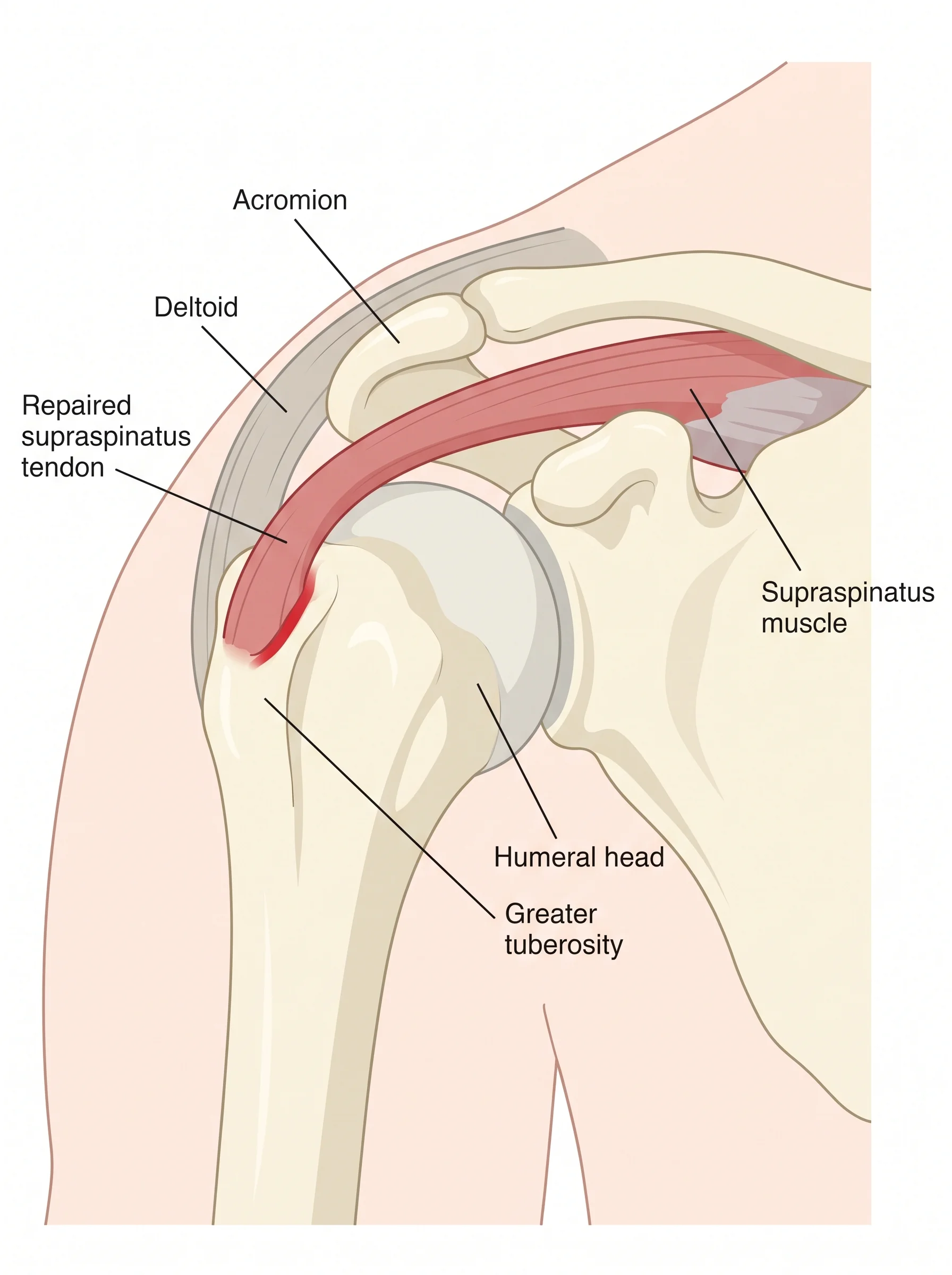
What is Rotator Cuff Repair?
The rotator cuff is a group of four tendons, the ropelike tissue that attaches muscle to bone, that hold the shoulder in its socket and lift the arm.
A tear means one of these tendons has pulled away from the bone. Rotator cuff repair is the surgery that anchors the torn tendon back to its place.
Repair is considered when non-surgical care has not restored comfort and strength, when a tear is large, or after a sudden tear in an active person. It is a choice made together, not an emergency for most tears.
Before surgery is discussed, non-surgical care comes first. The section below outlines what is tried before an operation and what the surgery itself involves.
What happens during Rotator Cuff Repair, step by step?
Rotator cuff repair is most often done with arthroscopy, a small camera passed through tiny incisions so the surgeon can see and work inside the joint.
Through these small openings, Dr. wodicka cleans the frayed tendon edges, prepares the bone, and uses small anchors with attached sutures to hold the tendon against the bone while it heals. Some larger or more complex tears are repaired through a small open incision instead. The approach depends on the size and shape of the tear and the quality of the tendon. Repair is usually an outpatient procedure, meaning most people go home the same day.
What is recovery like after Rotator Cuff Repair?
Recovery from rotator cuff repair happens in stages and calls for patience, because the tendon needs time to reattach to bone.
Most people wear a sling for a period after surgery to protect the repair, then begin gentle guided motion.
Physical therapy usually progresses from protected movement, to active motion, to strengthening over several months. Many people return to light daily activities within a few weeks, while fuller strength and return to demanding tasks or sports commonly takes around four to six months, according to general guidance from the American Academy of Orthopaedic Surgeons. These are ranges, not promises. Your timeline depends on the size of the tear, your health, and your rehabilitation. Your surgical team will map it with you.
Who performs rotator cuff repair in Fort Lauderdale?
ross wodicka is a orthopedic surgeon who performs rotator cuff repair in Fort Lauderdale, FL. Fellowship trained at southern california orthopaedic institute (scoi). Dr. wodicka sees patients at the practice in Fort Lauderdale; appointments can be requested through this site.
What do patients ask most often?
How long does it take to recover from rotator cuff repair?
Recovery unfolds over months. Many people return to light daily tasks within a few weeks, while fuller strength and return to demanding activity commonly takes around four to six months, according to general guidance from the American Academy of Orthopaedic Surgeons. These are ranges, not promises, and depend on the tear and your rehabilitation.
Will I need to wear a sling after surgery?
Yes, most people wear a sling for a period after rotator cuff repair to protect the tendon while it reattaches to the bone. The length of time varies with the size of the tear and the repair. Your surgical team will tell you how long to wear it and when to begin gentle motion.
Is rotator cuff repair done arthroscopically?
Most repairs are done with arthroscopy, using a small camera through tiny incisions, which allows the surgeon to work with small openings. Some larger or more complex tears are repaired through a small open incision. Dr. wodicka chooses the approach based on the size and shape of the tear.
How painful is recovery after rotator cuff repair?
Discomfort is expected in the early weeks and is managed with a plan from your surgical team, which may include medicine, ice, and positioning. Pain generally eases as healing progresses and therapy advances. Following the rehabilitation schedule helps protect the repair and supports a smoother recovery.
How do payments work?
Contact the office to confirm insurance participation.
This page is for general education and does not replace an evaluation by a physician. Individual treatment plans vary, and this content should not be used to self-diagnose.